
X-Rays
San Tan Valley (480) 457-1977
Gilbert (480) 963-9900
Mesa (480) 830-3344
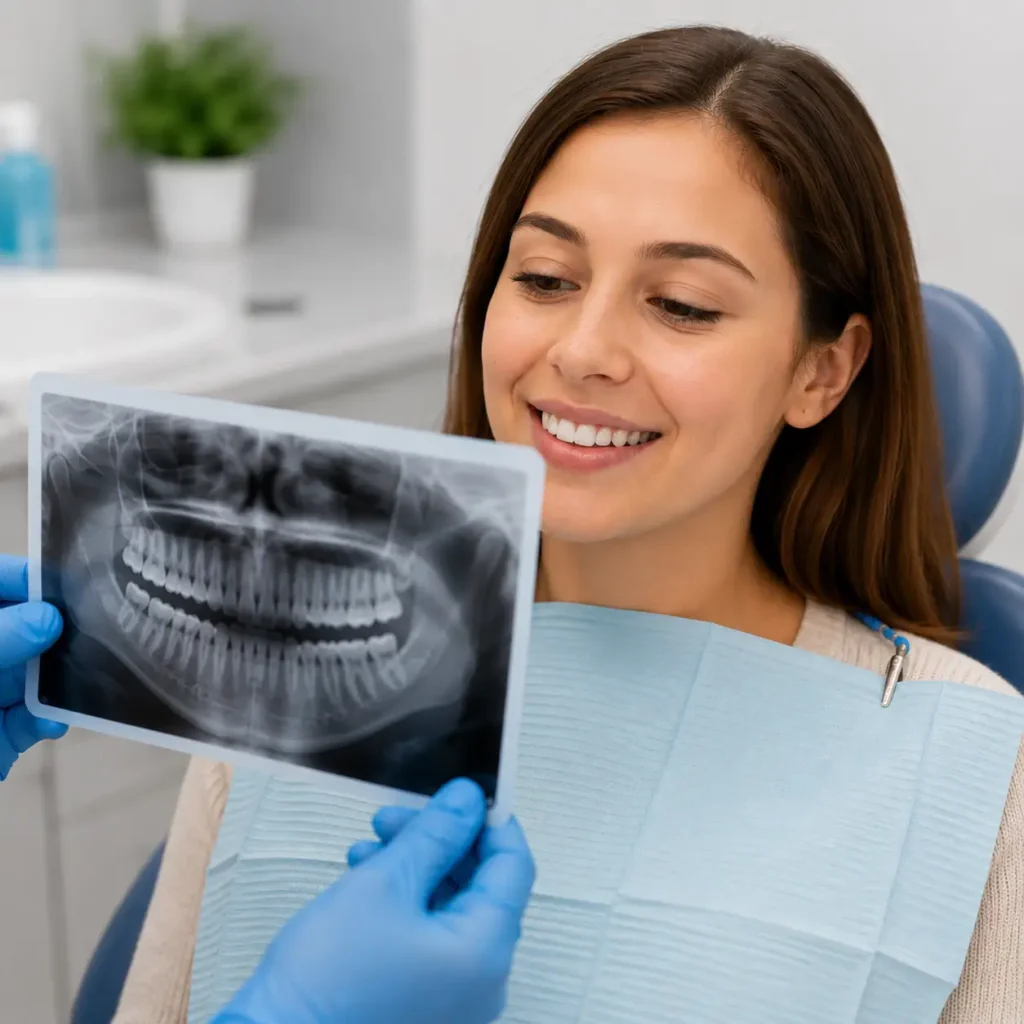
See What a Visual Dental Exam Cannot Show
Dental X-rays give your dentist a closer look at areas that are not fully visible during a routine examination, including between teeth, below the gumline, and around tooth roots and supporting bone. At Ocotillo Trails Family Dentistry in San Tan Valley, AZ, we use digital X-rays when clinically appropriate to help identify concerns such as hidden tooth decay, bone changes, infections, and problems beneath existing dental work. These images provide important diagnostic information that can help your dentist understand what is happening below the surface and recommend care based on a more complete view of your oral health.
Dental X-Rays Detail
When X-rays pass through your mouth during a dental exam, more X-rays are absorbed by the denser parts (such as teeth and bone) than by soft tissues (such as cheeks and gums) before striking the film. This creates an image on the radiograph. Teeth appear lighter because fewer X-rays penetrate to reach the film. Cavities and gum disease appear darker because of more X-ray penetration. The interpretation of these X-rays allows the dentist to safely and accurately detect hidden abnormalities.
How often dental X-rays (radiographs) should be taken depends on the patient`s individual health needs. It is important to recognize that just as each patient is different from the next, so should the scheduling of X-ray exams be individualized for each patient. Your medical and dental history will be reviewed and your mouth examined before a decision is made to take X-rays of your teeth.
The schedule for needing radiographs at recall visits varies according to your age, risk for disease and signs and symptoms. Recent films may be needed to detect new cavities, or to determine the status of gum disease or for evaluation of growth and development. Children may need X-rays more often than adults. This is because their teeth and jaws are still developing and because their teeth are more likely to be affected by tooth decay than those of adults.
Why Choose Us for Your Dental X-Rays?
At Ocotillo Trails Family Dentistry in San Tan Valley, AZ, dental X-rays help us see areas of your teeth and supporting structures that are not visible during a regular oral examination. Our team uses digital X-rays to support accurate evaluation, preventive care, and personalized treatment planning.
Digital X-Ray Technology
Our practice uses digital X-rays to capture detailed images of your teeth and surrounding structures. These images help our dental team evaluate areas that cannot always be examined clearly by looking inside the mouth alone.
Early Detection of Dental Concerns
Dental X-rays can help reveal cavities, bone changes, and other concerns that may not cause noticeable symptoms at first. Identifying these changes earlier can help us determine whether monitoring or treatment may be appropriate.
Personalized Imaging Recommendations
Not every patient needs the same type or frequency of dental X-rays. We consider your age, oral health, dental history, symptoms, and current treatment needs when deciding which images may be useful.
Support for Treatment Planning
X-ray images provide important information when planning certain dental treatments. They can help us evaluate tooth roots, surrounding bone, and other structures so treatment decisions are based on a more complete view of your oral health.
Clear Explanation of Findings
We want you to understand what we see during your dental evaluation. Our team can review relevant X-ray findings with you and explain how they relate to your teeth, gums, and recommended dental care.
Convenient San Tan Valley Location
Our San Tan Valley dental office makes it convenient for local patients and families to receive digital dental X-rays as part of routine examinations, preventive care, and treatment planning close to home.
Choose Ocotillo Trails Family Dentistry for digital dental X-rays in San Tan Valley, AZ. Our team uses detailed imaging alongside clinical examinations to help identify dental concerns, plan appropriate care, and support your long-term oral health.
Our Dental X-Ray Process: What to Expect
Dental X-rays help your dentist see areas of the teeth, roots, jawbone, and supporting structures that are not always visible during a routine examination. Usually, we begin by reviewing your dental needs, then determine which images are appropriate rather than taking X-rays unnecessarily.
1. Dental History and Needs Review
We begin by reviewing your dental history, current symptoms, previous X-rays, and any areas of concern. This helps determine whether new images are needed and what type may provide useful information.
2. Oral Examination
Your dentist examines your teeth, gums, bite, and surrounding tissues before deciding which images may be helpful. Findings during the exam often guide the location and number of X-rays taken.
3. X-Ray Selection and Preparation
When X-rays are appropriate, we select the images based on your individual dental needs. At Ocotillo Trails Family Dentistry, digital X-rays allow us to capture detailed images for diagnostic review.
4. Digital Image Capture
You are positioned carefully while the necessary images are taken. Depending on the area being examined, a small sensor may be placed inside your mouth to capture specific teeth and supporting structures.
5. Image Review and Evaluation
Your dentist reviews the X-rays for signs of decay, bone changes, tooth-root concerns, or other findings that may not be visible clinically. The images are considered alongside your examination.
6. Findings and Ongoing Monitoring
We explain relevant findings and discuss whether treatment or continued monitoring is appropriate. Future X-rays are recommended based on your oral health, risk factors, symptoms, and changes observed over time.
Kind words from our patients
“The dental X-rays were quick, and the team explained what they were looking for. I appreciated being able to understand areas that were not visible during the exam.”
“I liked how clearly the dentist reviewed my X-rays with me. Seeing the images made it easier to understand what was happening with my teeth.”
“The X-ray process was simple and comfortable. The team walked me through the images afterward and answered my questions without making anything feel complicated.”
Call Our Office to Find Out How We Can Help
Have questions about X-Rays? Our team is here to help you understand your options and find the right care for your needs. Whether you’re dealing with a concern now or just want expert advice, we’re ready to guide you every step of the way. Call today and let us show you how easy it is to get the care you need.
Neighborhoods We Serve
Ocotillo Trails Family Dentistry is proud to welcome patients from San Tan Valley and the surrounding communities, including:
Driving Directions to Our San Tan Valley Dental Office
Visiting Ocotillo Trails Family Dentistry for dental X-rays? Our office is at 40815 N Ironwood Rd #102, San Tan Valley, AZ 85140. Take N Ironwood Road toward E Ocotillo Road, enter the property near the intersection, and continue to Suite 102.
Dental X-Rays FAQs
Why might I need dental X-rays if nothing hurts?
Some dental problems develop before you notice pain or other symptoms. X-rays can help your dentist see areas between teeth, around roots, and below the gumline that cannot be fully examined by sight alone.
How often should I have dental X-rays taken?
That depends on your age, dental history, cavity risk, symptoms, and how recently images were taken. Some patients need X-rays more frequently, while others may go longer between images when their oral health is stable.
Are digital dental X-rays safe?
Digital dental X-rays use a low level of radiation and are taken only when the information is clinically useful. Ocotillo Trails Family Dentistry uses digital X-rays, which allow your dentist to review detailed images while limiting unnecessary exposure.
Do I need new X-rays if I recently moved to San Tan Valley?
Not necessarily. If your previous dentist has recent, useful images, ask whether they can be transferred to your new dental office. New X-rays may be recommended if the old images are outdated, incomplete, or do not show the areas your dentist needs to evaluate.
Will I need X-rays at every dental checkup?
Usually not. Dental X-rays should be based on your current needs rather than taken automatically at every visit. Your dentist can review your previous images, symptoms, and oral health before deciding whether new ones are necessary.
What should I tell the dental team before having X-rays?
Let them know if you are pregnant or think you may be pregnant, and mention any recent X-rays taken elsewhere. Sharing this information helps your dentist decide what imaging is appropriate and avoid repeating images unnecessarily.
Can I ask why a dental X-ray is being recommended?
Absolutely. Your dentist should be able to explain what they are looking for and how the image could affect your care. Knowing the purpose of the X-ray can help you make an informed decision about whether it is needed.